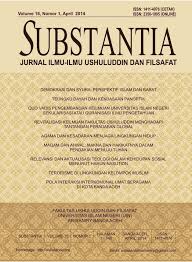
Notice on Citation & Reference Style Transition
Effective from Volume 29, Issue 1 (April 2027) onwards, Substantia: Jurnal Ilmu-Ilmu Ushuluddin officially adopts the American Psychological Association 7th Edition (APA 7th) format (author-date parenthetical citation and alphabetical reference list) with mandatory DOI inclusion.
For submissions published in or scheduled before the 2027 volume year, manuscripts continue to follow the legacy citation style (Chicago Manual of Style / Turabian Footnote-Bibliography format).
1. General Requirements
Substantia: Jurnal Ilmu-Ilmu Ushuluddin publishes original, peer-reviewed research articles and conceptual studies in the fields of Islamic Thought, Islamic Philosophy, Aqidah, Qur'anic and Hadith Studies, Comparative Religion, and Sociology of Religion.
- Originality: Manuscripts must be original, unpublished, and not under active consideration elsewhere.
- Language: Submissions are accepted in standard academic English, Arabic, or Indonesian.
- Length: Full research manuscripts should range between 5,000 and 8,000 words, including notes and references.
- File Format: Manuscripts must be submitted in Microsoft Word format (.doc or .docx), typed in single space on standard A4 layout.
2. Manuscript Structure and Formatting
Manuscripts should be organized systematically into the following standard sections:
- Title: Concise, informative, and reflecting the core research problem (max. 16 words).
- Abstract: Structured narrative (150–250 words) outlining the research background, primary objective/problem, methodology, key findings, and academic significance. All manuscripts must provide an English abstract; submissions in Indonesian or Arabic must provide bilingual abstracts (Indonesian and English).
- Keywords: 3 to 5 specific terms or short phrases, separated by semicolons, avoiding excessively broad words.
- Introduction: Synthesizes the background, academic literature gap, explicit novelty/contribution, theoretical foundation, and research problem.
- Method: Clear and reproducible explanation of research design, data collection, sources, corpus, analytical procedures, and validity measures.
- Results and Discussion: Clear presentation of findings followed by analytical discussion comparing outcomes with established scholarly literature.
- Conclusion: Summary of substantive findings, theoretical implications, limitations, and recommendations for future study.
- References: Comprehensive, alphabetically ordered list reflecting all in-text citations.
3. Referencing and Reference Management
Authors are required to manage all references using standardized reference-management software (e.g., Mendeley, Zotero, or EndNote).
- Reference Volume: A minimum of 25–30 references is strongly encouraged.
- Source Recency & Quality: At least 80% of references should be peer-reviewed primary research articles published in reputable journals within the last 5 to 10 years.
- DOI Assignment: Direct and active Digital Object Identifiers (DOIs in
https://doi.org/...format) must be attached to every applicable reference. - Citation Format: APA 7th Edition (Author, Year) format starting 2027 editions. (e.g., In-text:
(Nasr, 2021)orArkoun (2019) argued...).
4. Peer Review Process and Timeline
Substantia adheres to rigorous peer-review standards in line with COPE and Elsevier best practices:
- Double-Blind Review: All submissions undergo double-blind peer review by at least two independent expert reviewers. Author identities and affiliations must be completely anonymized in the submitted manuscript file.
- Evaluation Criteria: Manuscripts are assessed based on original contribution, methodological validity, analytical rigor, clarity of communication, and adherence to journal scope and ethical benchmarks.
- Review Duration: The initial screening (desk review) takes 1–2 weeks. The full review cycle typically takes 3 to 5 months from the date of submission.
- Editorial Decision: The Editorial Board retains ultimate authority over editorial decisions (Accept, Revisions Required, Resubmit for Review, or Decline).
5. Publication Ethics and Required Declarations
Mandatory Ethical Standards:
- Similarity Index: Manuscripts are screened using Turnitin. Submissions with a similarity index exceeding 20% (or significant unquoted text overlaps) will be returned or declined.
- Authorship & AI: All listed authors must meet ICMJE/COPE authorship criteria. AI systems cannot be listed as authors; any generative AI usage must be formally disclosed in accordance with the journal's Generative AI Policy.
- Declarations: Authors must state any potential Conflicts of Interest, Funding Sources, and Ethical Approvals (for empirical field studies involving human participants).