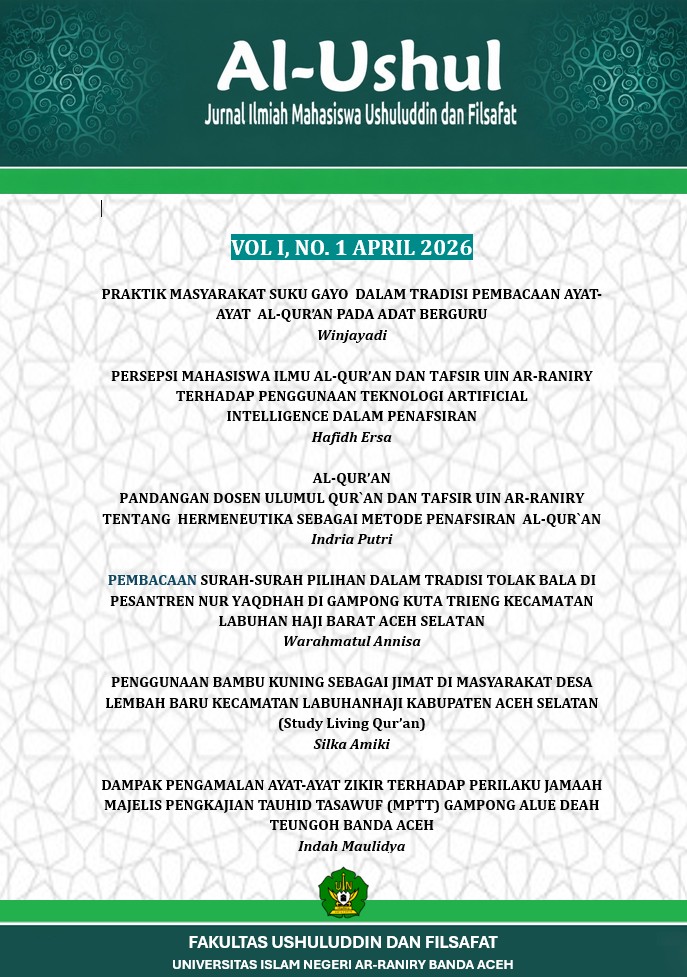
Penggunaan Artificial Intelligence dalam Studi Tafsir di Kalangan Mahasiswa IAT UIN Ar-Raniry Banda Aceh

- Submitted
- Published
Abstract
Generative artificial intelligence (AI) has increasingly become part of students’ academic activities, including Qur’anic exegesis studies. Yet, the ease of obtaining explanations from AI does not necessarily guarantee interpretive depth, traceable sources, or conformity with the methodological principles of tafsir. This study examines how students of Qur’anic Studies and Exegesis (IAT) at UIN Ar-Raniry use AI, evaluate its outputs, and verify them against other sources. It employs a descriptive qualitative approach, drawing primarily on semi-structured interviews with six IAT students and supporting documentation. The data were organized around students’ purposes for using AI, their assessments of AI-generated answers, and the ways they reported checking those answers. The findings indicate that AI, particularly ChatGPT, is used to obtain preliminary explanations of Qur’anic verses, accelerate information searches, and support academic assignments. Informants acknowledged its practical benefits but also considered some answers too general or insufficiently detailed, lacking clear references, or failing to make the application of tafsir methods explicit. To check AI-generated answers, students referred to tafsir works, digital sources, other AI platforms, and lecturers’ explanations. These findings suggest that AI is positioned as a supplementary and exploratory aid rather than a replacement for tafsir sources. Since the study relies on interviews, its findings describe the informants’ reported experiences and evaluations; they do not constitute an objective assessment of the accuracy of all AI-generated interpretations.
References
- Al-Janabi, Mahdi Kais Abdulkarim. “Artificial Intelligence in Quranic Exegesis: A Critical Analytical Study of ChatGPT Technology.” QURANICA - International Journal of Quranic Research 16, no. 2 (December 31, 2024): 112–44. https://doi.org/10.22452/QURANICA.VOL16NO2.5.
- Amoozadeh, Matin, David Daniels, Daye Nam, Aayush Kumar, Stella Chen, Michael Hilton, Sruti Srinivasa Ragavan, and Mohammad Amin Alipour. “Trust in Generative AI among Students: An Exploratory Study.” In Proceedings of the 55th ACM Technical Symposium on Computer Science Education V. 1, 2024. https://doi.org/10.1145/3626252.3630842.
- Andrean, Muhammad, and Idris Mardian Harahap. “Artificial Intelligence and Qur’anic Interpretation: A Critical Comparative Study of ChatGPT and Classical Tafsir.” Al-Fahmu: Jurnal Ilmu Al-Qur’an Dan Tafsir 4, no. 2 (September 30, 2025): 658–70. https://doi.org/10.58363/ALFAHMU.V4I2.641.
- Azizi, Afkar, and Nurullah. “Negotiating Qur’anic Interpretive Authority in the Age of Artificial Intelligence in Aceh.” TAFSE: Journal of Qur’anic Studies 10, no. 2 (December 30, 2025): 165–78. https://doi.org/10.22373/TAFSE.V10I2.33016.
- Bagasharov, Akhmetkazy, Mamyrova Zhantaeva, Kuzembayeva Khalizhan, Yemelianova Kurmanbayev, and Nurgazy Khaydarov. “Epistemology of Interpretation in the Era of Artificial Intelligence: Authority, Validity, and the Limits of AI’s Role in Quranic Interpretation.” Al-Qarawiyyin: Jurnal Ilmu Ushuluddin 2, no. 1 (2026). https://doi.org/10.64691/21y5h822.
- Bashir, Muhammad Huzaifa, Aqil M Azmi, Haq Nawaz, Wajdi Zaghouani, Mona Diab, Ala Al-Fuqaha, and Junaid Qadir. “Arabic Natural Language Processing for Qur’anic Research: A Systematic Review.” Artificial Intelligence Review 56, no. 7 (2023): 6801–54. https://doi.org/10.1007/s10462-022-10313-2.
- Chan, Cecilia Ka Yuk, and Wenjie Hu. “Students’ Voices on Generative AI: Perceptions, Benefits, and Challenges in Higher Education.” International Journal of Educational Technology in Higher Education 20 (2023): 43. https://doi.org/10.1186/s41239-023-00411-8.
- Faizin, Nur, Muhammad Alfan, Abdul Basid, Mochammad Rizal Ramadhan, Siti Aisyah Panatik, and Akhmad Nurul Kawakip. “Muslim Students’ Acceptance of Artificial Intelligence in Islamic Religious Education: An Extended TAM Approach.” Discover Education 2025 4:1 4, no. 1 (August 21, 2025): 304-. https://doi.org/10.1007/S44217-025-00767-1.
- Mainuddin, Hermawansyah, Muhammad Irfan, Junaidin, and Muh. Zulkifli. “Artificial Intelligence in Islamic Studies Courses: Opportunities and Limitations in Islamic Higher Education from Student Perspectives.” Al-Hayat: Journal of Islamic Education 9, no. 3 (September 5, 2025): 612–27. https://doi.org/10.35723/AJIE.V9I3.234.
- Miles, Matthew B., A. Michael Huberman, and Johnny Saldaña. Qualitative Data Analysis: A Methods Sourcebook. California: Sage Publications, 2014.
- Nordin, Mohd Khairul Naim Che, Nurin Aina Othman, Muhammad Hazim Mohd Azhar, Syed Mohammad Hilmi Syed Abdul Rahman, and Abdul Hannan Mohd Azhar. “The Use of Artificial Intelligence in Islamic Studies: An Analysis of Students’ Perceptions and the Need for Guidance Based on Islamic Values.” Jurnal Usuluddin 53, no. 2 (December 31, 2025): 109–48. https://doi.org/10.22452/USULUDDIN.VOL53NO2.5.
- Putra, Pristian Hadi, and Rifyal Novalia. “Pemanfaatan Chatbot AI Dalam Menjawab Pertanyaan Keislaman Di Kalangan Mahasiswa Pendidikan Islam.” Jurnal Riset Rumpun Agama Dan Filsafat 5, no. 1 (January 9, 2026): 194–209. https://doi.org/10.55606/JURRAFI.V5I1.7287.
- Rambe, Safrizal, Hasbi Alfi Maulana Silaen, Nur Khomisah Hasibuan, and Farid Adnir. “Hakikat Tafsir Dan Ruang Lingkupnya: Perbedaan Tafsir, Ta’wil Dan Terjemahannya.” Fatih: Journal of Contemporary Research 3, no. 1 (June 30, 2026): 630–39. https://doi.org/10.61253/XR9NNB16.
- Sahimi, Mohd Shafiq Bin, Mohd Hisyam Abdul Rahim, Arif Amin Bin Rushihi, Arwansyah Kirin, and Norazlina Zakaria. “Preserving the Authenticity of Quranic Exegesis Through Artificial Intelligence: A Proposed Framework for Digital Verification.” QURANICA - International Journal of Quranic Research 17, no. 2 (September 30, 2025): 325–44. https://doi.org/10.22452/QURANICA.VOL17NO2.13.
- Sahputra, Hery, Wahyu Ramadani Rambe, M. Naqsabandhi S, and Khoirul Anwar. “Al-Ashil Fi Al-Tafsir (Pengertian Dan Karakteristik).” Jurnal Riset Rumpun Agama Dan Filsafat 4, no. 2 (2025). https://doi.org/10.5281/zenodo.1586067.
- Salsabilla Manira, Nyak, and Nurhayati Selian. “Pengalaman Mahasiswa Dalam Menggunakan Artificial Intelligence Untuk Mendukung Belajar.” JURNAL RISET RUMPUN ILMU PENDIDIKAN 5, no. 1 (March 31, 2026): 51–62. https://doi.org/10.55606/JURRIPEN.V5I1.7229.
- Sholeh, Mohammad, Evi Fatimatur Rusydiyah, and M. Yunus Abu Bakar. “Integration of AI Chatbots in Islamic Religious Education: Potential and Challenges from a Doctoral Student Perspective.” AL-ISHLAH: Jurnal Pendidikan 16, no. 2 (June 30, 2024): 2105–21. https://doi.org/10.35445/ALISHLAH.V16I2.5409.
- Sofa, Nurul Aeni, Aang Kunaepi, and Nasikhin. “The Use of Chatgpt in Improving the Critical Thinking Skills of Islamic Education Graduates in Islamic Universities.” Edukasi: Jurnal Pendidikan Dan Pengajaran 11, no. 02 (December 24, 2024): 135–49. https://doi.org/10.19109/6CDCK053.
- Tsuria, Ruth, and Yossi Tsuria. “Artificial Intelligence’s Understanding of Religion: Investigating the Moralistic Approaches Presented by Generative Artificial Intelligence Tools.” Religions 2024, Vol. 15, Page 375 15, no. 3 (March 21, 2024): 375. https://doi.org/10.3390/REL15030375.
- Walters, William H, and Esther Isabelle Wilder. “Fabrication and Errors in the Bibliographic Citations Generated by ChatGPT.” Scientific Reports 13 (2023): 14045. https://doi.org/10.1038/s41598-023-41032-5.