
Abstract
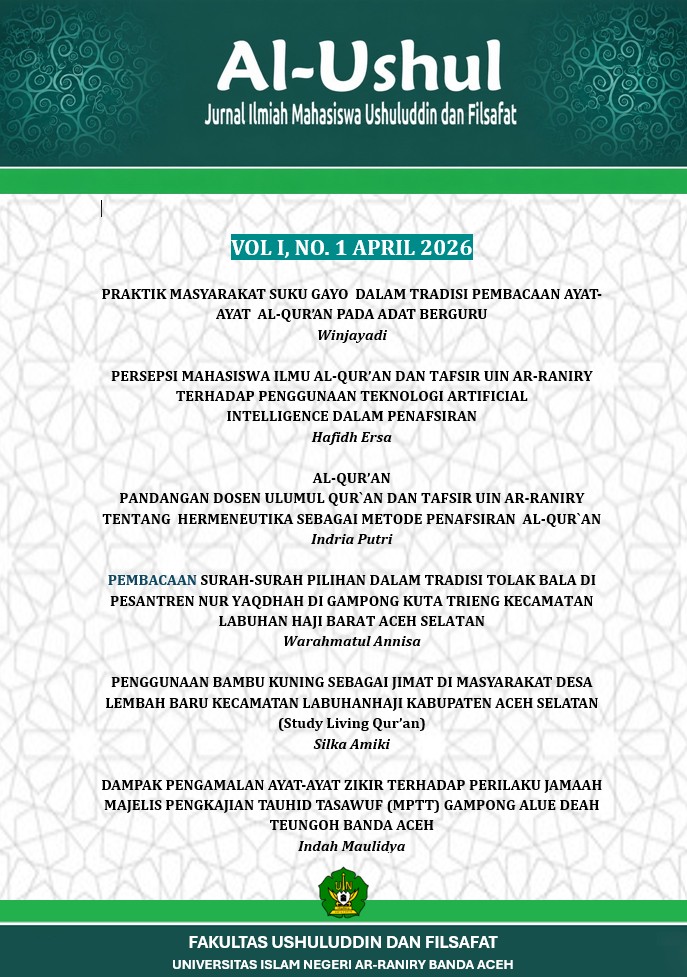
Debates on Qur’anic hermeneutics often oppose acceptance to rejection, overlooking differences between studying an approach, allowing its use, and endorsing its conclusions. This article examines how four lecturers in Qur’anic sciences and exegesis at UIN Ar-Raniry formulate these distinctions and justify the limits they place on interpretation. Using a qualitative descriptive approach, the study analyses documented interviews from field research with purposively selected informants. Available quotations and summaries are organised thematically and interpreted through comparison across informants and dialogue with recent scholarship. The findings identify overlapping but distinct positions. MNA separates interpretive tools from their results; IU permits methodological enrichment while resisting exclusivity; M acknowledges conditional use but prefers thematic exegesis; and SAB prioritises inherited exegetical disciplines while leaving interpretive products open to evaluation. The article develops three analytical levels of acceptance: intellectual receptivity, procedural permission, and evaluative endorsement. Evidence is strongest for receptivity and stated conditions of use; evaluations of particular thinkers do not establish endorsement of complete exegetical works. The contribution lies in identifying how apparently similar conditions conceal different methodological preferences and grounds of authority. These levels concern objects of judgment rather than successive stages of adoption, offering a more precise account of the documented controversy.
References
- Abdul-Jabbar, Wisam Kh. “On the Art of Ta’wil: The Pedagogy of Hermeneutics for Izntercultural and Interfaith Dialogue.” Religions 17, no. 8 (2026): 967. https://doi.org/10.3390/rel17080967.
- Abou El Fadl, Khaled. Speaking in God’s Name: Islamic Law, Authority and Women. Oxford: Oneworld, 2001.
- Alak, Alina Isac. “The Islamic Humanist Hermeneutics: Definition, Characteristics, and Relevance.” Islam and Christian–Muslim Relations 34, no. 4 (2023): 313–336. https://doi.org/10.1080/09596410.2023.2282842.
- Ansori. “The Hermeneutics of Khaled M. Abou El-Fadl and Its Relevance with Religious Moderation in Indonesia.” Khazanah: Jurnal Studi Islam dan Humaniora 20, no. 2 (2022): 263–278. https://doi.org/10.18592/khazanah.v20i2.7462.
- Braun, Virginia, dan Victoria Clarke. Thematic Analysis: A Practical Guide. London: SAGE, 2022.
- Creswell, John W., dan Cheryl N. Poth. Qualitative Inquiry and Research Design: Choosing Among Five Approaches. Ed. ke-4. Los Angeles: SAGE, 2018.
- Gadamer, Hans-Georg. Truth and Method. Ed. revisi ke-2. Diterjemahkan oleh Joel Weinsheimer dan Donald G. Marshall. London: Continuum, 2004.
- Husaini, Adian, dan Abdurrahman al-Baghdadi. Hermeneutika dan Tafsir Al-Qur’an. Jakarta: Gema Insani, 2007.
- Kulinich, Alena. “‘Personal Opinion’ in Qurʾānic Exegesis: Medieval Debates and Interpretations of al-Tafsīr bi-l-Raʾy.” Der Islam 99, no. 2 (2022): 476–513. https://doi.org/10.1515/islam-2022-0024.
- Muhibudin, Fahmi Islam Jiwanto, dan Samsul Maarif. “Preserving the Purity of Revelation: The Challenge of Hermeneutics to Qur’anic Da‘wah.” Al-Risalah: Jurnal Studi Agama dan Pemikiran Islam 16, no. 2 (2025): 347–367. https://doi.org/10.34005/alrisalah.v16i2.4834.
- Nuraini, Waharjani, dan Mohammad Jailani. “From Textual to Contextual: Contemporary Islamic Thinker Abdullah Saeed on Qur’anic Exegesis.” Jurnal Ilmiah Al-Mu’ashirah 21, no. 1 (2024): 32–49. https://doi.org/10.22373/jim.v21i1.19639.
- Pink, Johanna. Muslim Qur’anic Interpretation Today: Media, Genealogies and Interpretive Communities. Sheffield: Equinox, 2019.
- Rahman, Fazlur. Islam and Modernity: Transformation of an Intellectual Tradition. Chicago: University of Chicago Press, 1982.
- Ridho, Hilmi, Afif Sabil, Mohammad Firmansyah, Febri Hijroh Mukhlis, dan Aizat Khairi. “Interpretation of the Qur’an from Classical-Textual to Contemporary-Contextual; An Approach Proposed by Muslim Scholars.” QiST: Journal of Quran and Tafseer Studies 4, no. 2 (2025): 645–674. https://doi.org/10.23917/qist.v4i2.12593.
- Saeed, Abdullah. Interpreting the Qur’an: Towards a Contemporary Approach. London dan New York: Routledge, 2006.
- Saeed, Abdullah. Reading the Qur’an in the Twenty-First Century: A Contextualist Approach. Abingdon dan New York: Routledge, 2014.
- Saeed, Sohaib. “Exegetical Qur’an Translation: Theoretical and Practical Considerations.” Journal of College of Sharia and Islamic Studies 43, no. 2 (2025): 255–279. https://doi.org/10.29117/jcsis.2025.0424.
- Schleiermacher, Friedrich. Hermeneutics and Criticism and Other Writings. Disunting dan diterjemahkan oleh Andrew Bowie. Cambridge: Cambridge University Press, 1998.
- Suyūṭī, Jalāl al-Dīn ʿAbd al-Raḥmān al-. Al-Itqān fī ʿUlūm al-Qurʾān. Disunting oleh Muḥammad Abū al-Faḍl Ibrāhīm. Kairo: al-Hayʾah al-Miṣriyyah al-ʿĀmmah li al-Kitāb, 1974.
- Syamsuddin, Sahiron. Hermeneutika dan Pengembangan Ulumul Qur’an. Yogyakarta: Pesantren Nawesea Press, 2009.
- Zarkashī, Badr al-Dīn Muḥammad ibn ʿAbd Allāh al-. Al-Burhān fī ʿUlūm al-Qurʾān. Disunting oleh Muḥammad Abū al-Faḍl Ibrāhīm. Kairo: Dār Iḥyāʾ al-Kutub al-ʿArabiyyah, 1957.
- Zulfa, Imarotuz. “Sahiron Syamsuddin’s Contributions to the Methodological Discourse of Al-Qur’an Interpretation in Indonesia.” TAFSE: Journal of Qur’anic Studies 8, no. 2 (2023): 141–152. https://doi.org/10.22373/tafse.v8i2.20133.