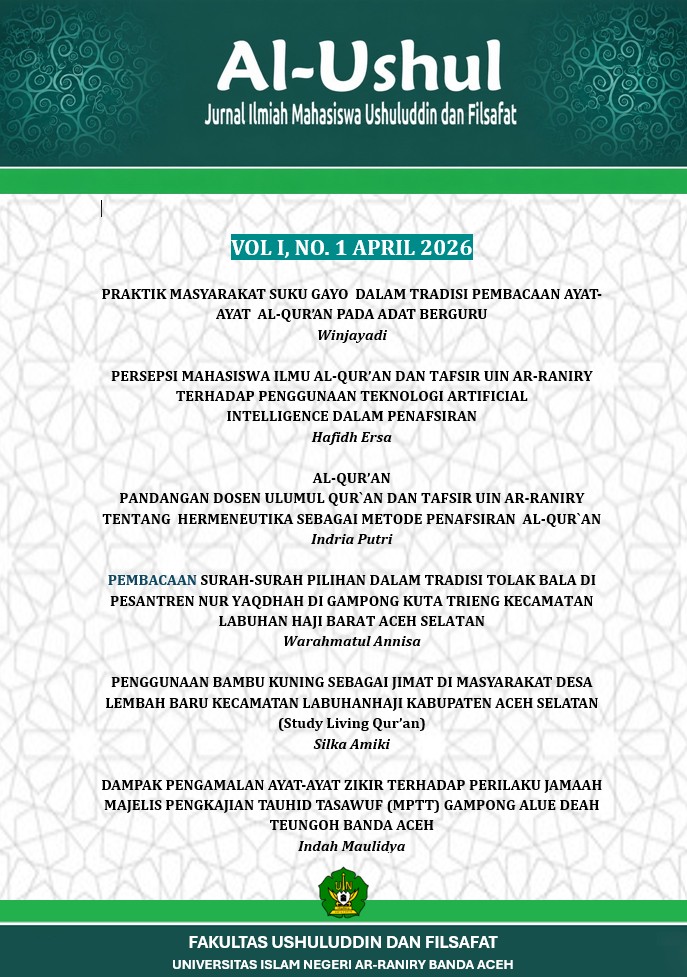
Vol. 1 No. 1 (2026)
 pp. 1 – 82
5 Articles
Articles
Penggunaan Artificial Intelligence dalam Studi Tafsir di Kalangan Mahasiswa IAT UIN Ar-Raniry Banda Aceh
Abstract
Generative artificial intelligence (AI) has increasingly become part of students’ academic activities, including Qur’anic exegesis studies. Yet, the ease of obtaining explanations from AI does not necessarily guarantee interpretive depth, traceable sources, or conformity with the methodological principles of tafsir. This study examines how students of Qur’anic Studies and Exegesis (IAT) at UIN Ar-Raniry use AI, evaluate its outputs, and verify them against other sources. It employs a descriptive qualitative approach, drawing primarily on semi-structured interviews with six IAT students and supporting documentation. The data were organized around students’ purposes for using AI, their assessments of AI-generated answers, and the ways they reported checking those answers. The findings indicate that AI, particularly ChatGPT, is used to obtain preliminary explanations of Qur’anic verses, accelerate information searches, and support academic assignments. Informants acknowledged its practical benefits but also considered some answers too general or insufficiently detailed, lacking clear references, or failing to make the application of tafsir methods explicit. To check AI-generated answers, students referred to tafsir works, digital sources, other AI platforms, and lecturers’ explanations. These findings suggest that AI is positioned as a supplementary and exploratory aid rather than a replacement for tafsir sources. Since the study relies on interviews, its findings describe the informants’ reported experiences and evaluations; they do not constitute an objective assessment of the accuracy of all AI-generated interpretations.
Pembacaan Ayat-Ayat Al-Qur’an dalam Tradisi Berguru Masyarakat Gayo
Abstract
This study examines the recitation of Qur’anic verses within the berguru tradition, a pre-marital counseling sequence in Gayo customary weddings in Central Aceh and Bener Meriah, Indonesia, using a Living Qur’an perspective. While prior studies have examined berguru through the lenses of marriage culture, intercultural communication, and da’wah, none has analyzed it as a form of Qur’anic reception. This qualitative field research collected data through observation, in-depth interviews, and documentation with purposively sampled informants, including customary and religious leaders, village officials, members of the Gayo Customary Council (Majelis Adat Gayo), and community members who had undergone the tradition. Findings show that Qur’anic verses are recited during the culminating ejer muarah session, selected thematically according to marriage, spousal responsibility, and family ethics, following both a general and a context-specific pattern tailored to the bride or groom’s circumstances. The recitation functions as a medium of pre-marital education, da’wah, social control, social integration, and cultural preservation, positioning the Qur’an as a living source of guidance rather than a mere ceremonial accessory. The study concludes that berguru represents an integrative relation between adat and Islamic teaching, constituting both a social and a functional reception of the Qur’an, and contributes a new context to Living Qur’an scholarship in Indonesia beyond formal religious ritual
Hermeneutika dan Otoritas Penafsiran Al-Qur’an di Kalangan Dosen IAT UIN Ar-Raniry Banda Aceh
Abstract
Debates on Qur’anic hermeneutics often oppose acceptance to rejection, overlooking differences between studying an approach, allowing its use, and endorsing its conclusions. This article examines how four lecturers in Qur’anic sciences and exegesis at UIN Ar-Raniry formulate these distinctions and justify the limits they place on interpretation. Using a qualitative descriptive approach, the study analyses documented interviews from field research with purposively selected informants. Available quotations and summaries are organised thematically and interpreted through comparison across informants and dialogue with recent scholarship. The findings identify overlapping but distinct positions. MNA separates interpretive tools from their results; IU permits methodological enrichment while resisting exclusivity; M acknowledges conditional use but prefers thematic exegesis; and SAB prioritises inherited exegetical disciplines while leaving interpretive products open to evaluation. The article develops three analytical levels of acceptance: intellectual receptivity, procedural permission, and evaluative endorsement. Evidence is strongest for receptivity and stated conditions of use; evaluations of particular thinkers do not establish endorsement of complete exegetical works. The contribution lies in identifying how apparently similar conditions conceal different methodological preferences and grounds of authority. These levels concern objects of judgment rather than successive stages of adoption, offering a more precise account of the documented controversy.
Resepsi Fungsional Al-Qur’an dalam Tradisi Tolak Bala di Pesantren Nur Yaqdhah Aceh Selatan
Abstract
Qur’anic recitation in protective rituals raises questions about how numerical prescriptions relate to individual and congregational practice. This article examines recitation sequences, numerical repetition, water, and religious authority in the Tolak Bala tradition at Pesantren Nur Yaqdhah, South Aceh. Using a descriptive qualitative approach, it analyses documented interviews, observation notes, and accounts of local devotional practice through the framework of functional reception. The findings identify a sequence connecting selected Qur’anic passages, supplication, walking around the pesantren grounds, and a four-unit prayer described by participants. Forty-one recitations of Yāsīn provide a prescribed reference, while one collective recitation is considered sufficient when participation exceeds forty-one people. The numbers function primarily as inherited instructions rather than as explicitly articulated numerical symbolism. Al-Insyirāḥ is associated with relief from hardship, and water placed near the recitation expresses hopes for blessing and healing. Daily devotional routines provide a setting for transmitting these practices. The article argues that numerical prescription and collective sufficiency are connected through locally recognized religious authority. Its contribution is to explain this relationship within functional reception rather than to claim the uniqueness of individual ritual elements. Chronological and attributional limitations restrict conclusions about actual performance and the uniformity of participants’ interpretations.
Antara Perlindungan Spiritual dan Legitimasi Keagamaan: Praktik Jimat Bambu Kuning dalam Perspektif Living Qur’an di Aceh Selatan
Abstract
The practice of using yellow bamboo as an amulet is still found among some Muslim communities in Lembah Baru Village, South Aceh Regency. Unlike amuletic practices in general, the use of yellow bamboo in this tradition is consistently accompanied by selected Qur'anic verses. This study analyzes the community's reception of these verses in the yellow bamboo practice and explores the meanings constructed through this tradition. Employing a qualitative approach within the Living Qur’an perspective, the study collected data through observation, in-depth interviews, and documentation, combined with Ahmad Rafiq's theory of Qur'anic reception. The findings reveal that the community incorporates the basmalah, Sūrat al-Fātiḥah, Q.S. al-Aḥqāf [46]:32, and Sūrat al-Nās as integral elements of the yellow bamboo practice, with varying degrees of departure from their textual meanings. These verses are received functionally as a means of protection, warding off misfortune, and attaining spiritual tranquility, while also serving as a mechanism of religious legitimation that sustains the yellow bamboo tradition within the Muslim community. The study further finds differing views between community members and local religious figures regarding the limits of using material media to seek protection, indicating that the functional reception of the Qur'an in cultural practice remains an ongoing negotiation between religious experience and normative religious authority.