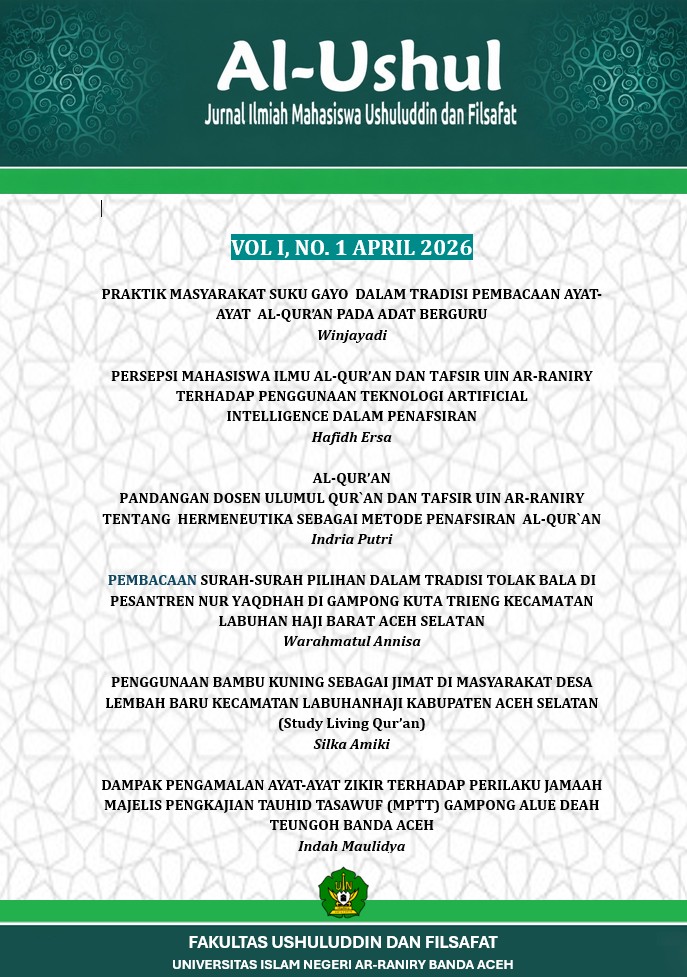
Antara Perlindungan Spiritual dan Legitimasi Keagamaan: Praktik Jimat Bambu Kuning dalam Perspektif Living Qur’an di Aceh Selatan

- Submitted
- Published
Abstract
The practice of using yellow bamboo as an amulet is still found among some Muslim communities in Lembah Baru Village, South Aceh Regency. Unlike amuletic practices in general, the use of yellow bamboo in this tradition is consistently accompanied by selected Qur'anic verses. This study analyzes the community's reception of these verses in the yellow bamboo practice and explores the meanings constructed through this tradition. Employing a qualitative approach within the Living Qur’an perspective, the study collected data through observation, in-depth interviews, and documentation, combined with Ahmad Rafiq's theory of Qur'anic reception. The findings reveal that the community incorporates the basmalah, Sūrat al-Fātiḥah, Q.S. al-Aḥqāf [46]:32, and Sūrat al-Nās as integral elements of the yellow bamboo practice, with varying degrees of departure from their textual meanings. These verses are received functionally as a means of protection, warding off misfortune, and attaining spiritual tranquility, while also serving as a mechanism of religious legitimation that sustains the yellow bamboo tradition within the Muslim community. The study further finds differing views between community members and local religious figures regarding the limits of using material media to seek protection, indicating that the functional reception of the Qur'an in cultural practice remains an ongoing negotiation between religious experience and normative religious authority.
References
- Ahimsa-Putra, Heddy Shri. “The Living Al-Qur’an: Beberapa Perspektif Antropologi.” Walisongo: Jurnal Penelitian Sosial Keagamaan 20, no. 1 (2012): 235–60. https://doi.org/10.21580/ws.20.1.198.
- Ahmad Rafiq. “Teks Dan Praktik Dalam Fungsi Kitab Suci: Sebuah Pengantar.” In Living Qur’an: Teks, Praktik Dan Idealitas Dalam Performasi Al-Qur’an, v. Yogyakarta: Lembaga Ladang Kata, 2020.
- al-Bukhari, Muhammad ibn Ismail. Ṣaḥīḥ Al-Bukhārī, 2026. https://sunnah.com/bukhari:5736.
- Annisa, Nur, Ihsan Nurmansyah, and Sherli Kurnia Oktaviana. “Living Qur’an Di Era Digital: Analisis Resepsi Estetis Dan Fungsional Atas Adegan Ruqyah Dalam Film Qodrat.” Mafatih 4, no. 2 (October 23, 2024): 107–26. https://doi.org/10.24260/mafatih.v4i2.4148.
- Anshori, Muhammad Helmi, Abdul Muhaimin, Aulul Azmi, and Ahmad Fathoni. “Resepsi Fungsional Al-Qur’an Dalam Tradisi Keagamaan Lokal: Studi Atas Tradisi Roah Kemalik Pada Masyarakat Rembiga, Nusa Tenggara Barat.” Al-Qudwah: Jurnal Studi Al-Qur’an Dan Hadis 3, no. 1 (June 10, 2025): 75–92. https://doi.org/10.24014/ALQUDWAH.V3I1.29784.
- ———. “Resepsi Fungsional Al-Qur’an Dalam Tradisi Keagamaan Lokal: Studi Atas Tradisi Roah Kemalik Pada Masyarakat Rembiga, Nusa Tenggara Barat.” Al-Qudwah: Jurnal Studi Al-Qur’an Dan Hadis 3, no. 1 (October 23, 2025): 75–92. https://doi.org/10.24014/alqudwah.v3i1.29784.
- Asad, Talal. “The Idea of an Anthropology of Islam.” Qui Parle 17, no. 2 (October 23, 2009): 1–30. https://www.jstor.org/stable/20685738.
- Berger, Peter L, and Thomas Luckmann. The Social Construction of Reality: A Treatise in the Sociology of Knowledge. Vintage, 1967. https://www.penguinrandomhouse.com/books/12390/the-social-construction-of-reality-by-peter-l-berger/.
- Berry, John, Ype H. Poortinga, Marshall H. Segall, and Pierre R. Dasen. Cross-Cultural Psychology: Research and Applications. 2nd ed. Cambridge: Cambridge University Press, 2002.
- Faizin, Hamam. “Mencium Dan Nyunggi Al-Qur’an Upaya Pengembangan Kajian Al-Qur’an Melalui Living Qur’an.” SUHUF 4, no. 1 (October 23, 2011): 23–40. https://doi.org/10.22548/shf.v4i1.63.
- Ibn Kathir, Ismail ibn Umar. “Tafsir Ibn Kathir (Abridged): Surah Al-Ahqaf, Ayat 32.” Quran.com, October 23, 2026. https://quran.com/46:32/tafsirs/en-tafisr-ibn-kathir.
- Junaedi, Didi. “Living Qur’an: Sebuah Pendekatan Baru Dalam Kajian Al-Qur’an (Studi Kasus Di Pondok Pesantren As-Siroj Al-Hasan Desa Kalimukti Kec. Pabedilan Kab. Cirebon).” Journal of Qur’an and Hadith Studies 4, no. 2 (October 23, 2015): 169–90. https://doi.org/10.15408/quhas.v4i2.2392.
- Miles, Matthew B, and A Michael Huberman. Qualitative Data Analysis: An Expanded Sourcebook. 2nd ed. Thousand Oaks: SAGE Publications, 1994. https://library.strathmore.edu/Record/24274.
- Nurullah, and Ari Handasa. “Penggunaan Ayat-Ayat Al-Qur’an Sebagai Jimat.” TAFSE: Journal of Qur’anic Studies 5, no. 2 (October 23, 2020): 82–97. https://doi.org/10.22373/tafse.v5i2.9082.
- Pargament, Kenneth I. The Psychology of Religion and Coping: Theory, Research, Practice. Guilford Press, 1997. https://cms.guilford.com/books/The-Psychology-of-Religion-and-Coping/Kenneth-Pargament/9781572306646/contents.
- Park, Crystal L. “Religion as a Meaning-Making Framework in Coping with Life Stress.” Journal of Social Issues 61, no. 4 (October 23, 2005): 707–29. https://doi.org/10.1111/j.1540-4560.2005.00428.x.
- Rafiq, Ahmad. “Sejarah Al-Qur’an: Dari Pewahyuan Ke Resepsi (Sebuah Pencaraian Awal Metodologis).” In Islam, Tradisi Dan Peradaban, edited by SUKA-Press, Vol. 1. Yogyakarta, 2012. https://digilib.uin-suka.ac.id/id/eprint/57563/1/Sejarah al-Quran dari Pewahyuan ke Resepsi %28Sebuah Pencarian Awal Metodologis%29.pdf.
- ———. “The Living Qur’an: Its Text and Practice in the Function of the Scripture.” Jurnal Studi Ilmu-Ilmu Al-Qur’an Dan Hadis 22, no. 2 (2021): 469–84. https://doi.org/10.14421/qh.2021.2202-10.
- ———. “The Reception of the Qur’an in Indonesia: A Case Study of the Place of the Qur’an in a Non-Arabic Speaking Community.” Temple University, 2014.
- Sukamto. Perjumpaan Antar Pemeluk Agama Di Nusantara. Yogyakarta: Deepublish, 2018.
- Susanto, Ardi Tri, Ghina Salsabila, Edi Komarudin, and Jajang A Rohmana. “Living Qur’an: Interaksi Umat Islam Dengan Al-Qur’an.” Kalamizu: Jurnal Sains, Sosial, Dan Studi Agama 1, no. 8 (December 10, 2025): 892–904. https://hamfara.com/kalamizu/article/view/100.
- Syamsudin, Sahiron. “Metodologi Penelitian Living Qur’an Dan Hadis.” TH-Press, 2007.
- Yunus, Moch Barkah. “Resepsi Fungsional Al-Qur’an Sebagai Syifā’ Di Pondok Pesantren Roudhotut Tholabah Ki Ageng Serang Purwodadi.” Universitas Islam Negeri Walisongo Semarang, 2019. https://eprints.walisongo.ac.id/id/eprint/10348/.